

Baffling reason you get stuck in traffic even with no accidents or road closures

Mirror
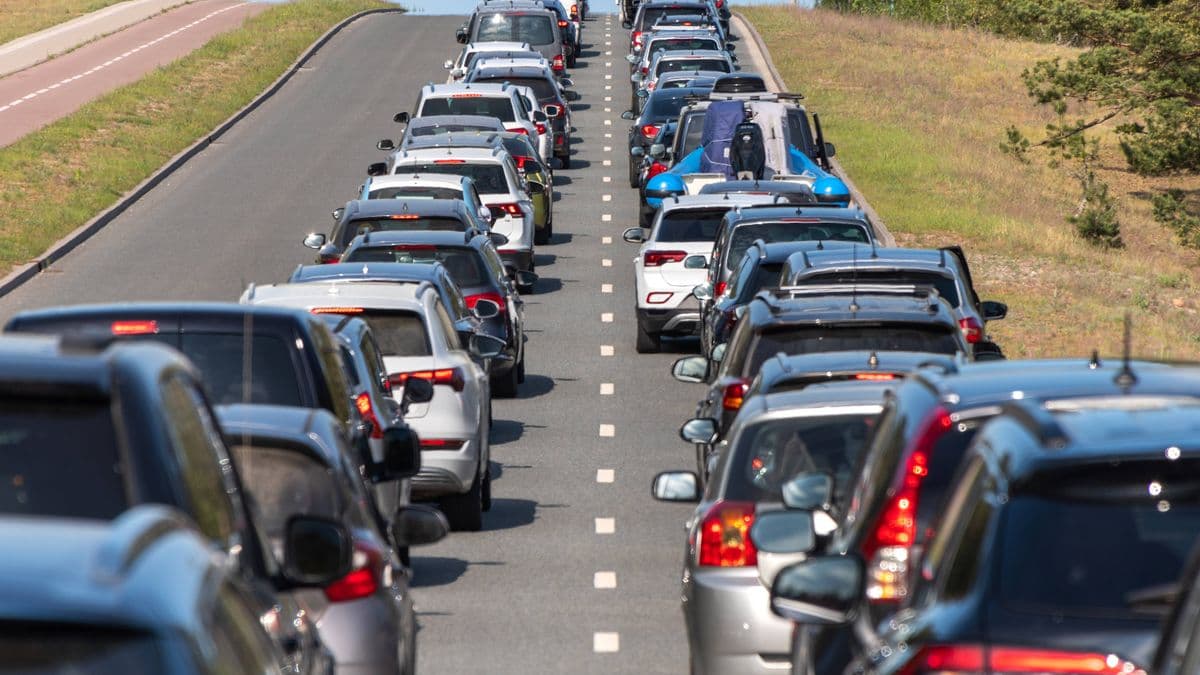
If you've ever found yourself stuck in a traffic jam for no apparent reason, it turns out science might be to blame.
We've all experienced it: cruising along the motorway when suddenly you're forced to halt behind a long queue of vehicles. Your immediate thought is that there must have been an accident up ahead, or perhaps an unexpected road closure, but as you inch closer, it becomes clear there was no obvious cause for the standstill.
Once you reach the front of the traffic jam, you're able to continue your journey unhindered, with no evidence of a recent accident or any road closures.
Whilst most of us would simply shrug this off as one of life's enigmas, a mathematician on social media has offered a scientific explanation for these "phantom jams", which are apparently more frequent than we might imagine.
Professor Hannah Fry posted a video on YouTube explaining that these inexplicable traffic jams are actually triggered by minor alterations in the driving behaviour of those ahead, causing those following to brake. This is why they're most prevalent on motorways, where vehicles typically travel at higher speeds.
She explained: "When you are in that situation, you're not stuck behind a crash. Your day has just been ruined by a mathematical ghost.
"The official name for this is a phantom jam, and we've known about it since about the 1950s, when mathematicians realised that when a motorway gets too crowded, people stop behaving like individual cars and instead, the entire motorway starts behaving according to the rules of fluid dynamics.
"Here is how the ghost is born. When the traffic gets really dense, the cars are driving quite close to each other. Maybe at some point, somebody changes lanes or taps their brakes a bit too hard, but crucially, causes the person behind them to have to brake.
"That means the person behind them has to brake, the person behind them has to brake, and so on and so on. Because of human reaction times, the amount of braking increases as you go further back, until you get to about 20 cars, when the amplification is so big that the car has to come to a complete dead stop."
Hannah continued by saying that phantom jams don't occur in one fixed spot, meaning you're not heading towards where the congestion started. Rather, the traffic jam forms a "wave" that travels backwards in your direction.
She noted the phantom jam will only clear once it eventually arrives at a stretch of road where vehicles are sufficiently spaced apart that drivers don't need to reduce speed to avoid colliding with the car ahead. However, the mathematician insisted there's a solution to prevent phantom traffic jams from occurring, and it involves avoiding something drivers shouldn't be doing, regardless – tailgating.
Tailgating refers to driving excessively close to the vehicle ahead, and it's a hazardous practice that constitutes careless driving, potentially resulting in a £100 fine and penalty points on your licence. Despite this, numerous motorists continue the behaviour, which can force them to brake suddenly to avoid collisions, consequently triggering phantom congestion on congested routes.
Hannah explained: "So how do you defeat this mathematical ghost? Two options, really. Either we can all get in driverless cars with much better reaction times, or we can all just agree to stop tailgating.
"But in the absence of a minor miracle, unfortunately, there's nothing that you as a driver are going to be able to do. So if you find yourself in this situation where you're on the motorway, stuck in traffic with no sign of a crash, you just need to sit back, take a deep breath, and let the mathematical ghost wash past you."