

The Surprisingly Global History of Monobloc, the Chair Vietnam Loves and the West Despises
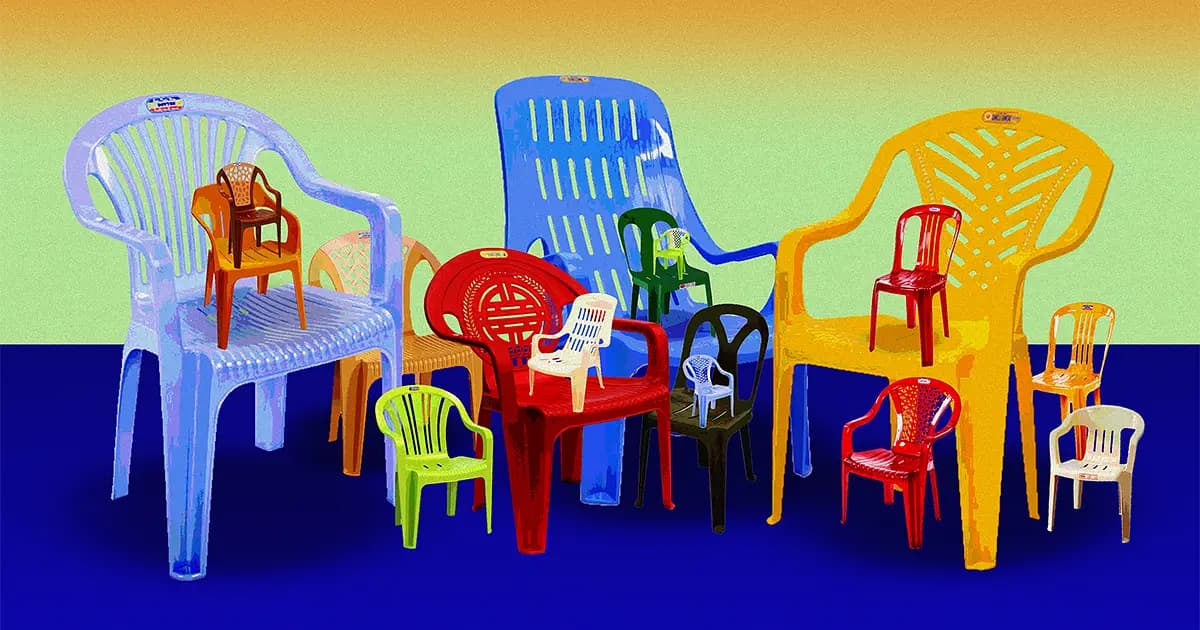
Vietnamese news sources quickly reported on the story. They talked about the chair's role in Vietnam's social gatherings and how it's always present at beer stalls and family courtyards.
The Monobloc was the only entry without a credited creator.
There were different opinions about the chair's inclusion on the list. Some people celebrated its ubiquity, while others thought it was just a cheap, ugly chair.
People around the world have different feelings about the Monobloc. Some hate it and think it's an eyesore, while others like it for being cheap and practical.
The local press in Vietnam was excited about the Monobloc making the list.
The Monobloc is a simple chair, but it can be both loved and hated. What is it about the chair that makes people feel this way?
To understand the Monobloc, we need to look at its history.
The Monobloc is made from a single piece of plastic, usually polypropylene. It's made by melting the plastic and shaping it into a chair.
The chair first appeared after World War II, when countries were becoming more industrialized. Plastic was seen as a great material for furniture because it was light, durable, and didn't require wood or metal.
Designers started experimenting with plastic to make furniture that was flexible, inexpensive, and accessible to everyone.
There were other chairs like the Monobloc before it, such as the Panton Chair and the Bofinger Chair.
The Fauteuil 300, introduced in 1972, was similar to the Monobloc we know today.
The Resin Garden Chair, launched in 1983, was a major turning point for the Monobloc. It was designed for the mass market and had low production costs.
The Monobloc is a well-designed chair. It has a perforated backrest to drain rainwater and a curved back to support the sitter.
The production process for the Monobloc is quick and efficient. It takes less than two minutes to make a chair.
The mold used to make the Monobloc is the most expensive part of the process. A single mold can produce millions of chairs.
The Monobloc is a practical and economical chair. It's made to be produced in large quantities.
The chair became popular in Europe and North America, but it was also criticized for being ugly and cheap.
In some cities, the Monobloc is banned from public spaces because it's seen as clutter.
The Monobloc is often thrown away instead of being repaired, which contributes to the plastic waste crisis.
In other parts of the world, the Monobloc is seen as a valuable resource. It's used in ingenious ways and is a symbol of resourcefulness.
The documentary Monobloc shows how the chair is used in different countries. It's welcomed and utilized in many places.
In India, the Monobloc has made a big difference. It's provided affordable seating for many people and has helped reduce the demand for wooden furniture.
The Monobloc is used in different ways around the world. It's a versatile chair that can be adapted to many situations.
In Brazil, broken plastic chairs are collected and recycled into new objects. The Monobloc is a vital part of the local circular economy.
In Uganda, the Monobloc is used to make low-cost wheelchairs. It's a simple and effective solution that has helped many people.
The Monobloc has a different meaning in different contexts. It's a symbol of resourcefulness in some places and a symbol of waste in others.
In affluent societies, the Monobloc is often seen as a symbol of bad taste. It's dismissed as a cheap, ugly chair.
The Monobloc is a complex object that can be seen in many different ways. It's a reflection of our values and our relationship with the environment.
The chair's meaning is shaped by our experiences and our culture. It's a universal object that can be interpreted in many different ways.
As a Vietnamese person, I have a personal connection to the Monobloc. It's a part of my daily life and my culture.
The Monobloc has provided a livelihood for many people in Vietnam. It's a symbol of stability and practicality.
I'm grateful for the Monobloc because it's provided seating for many people in Vietnam. It's a simple chair that has made a big difference.
The Monobloc is a fact of life in Vietnam. It's not seen as a symbol of bad taste or a waste of resources.
I've had many good experiences with the Monobloc. It's a chair that's always there, providing a place to sit and relax.
The Monobloc is a part of Vietnamese culture. It's a symbol of resourcefulness and practicality.
The chair's aesthetic or social merits are not discussed in Vietnam. It's simply a part of everyday life.
The Monobloc is a global object that has different meanings in different contexts. It's a reflection of our values and our relationship with the environment.