

Whale Worship in Vietnam's Coastal Communities
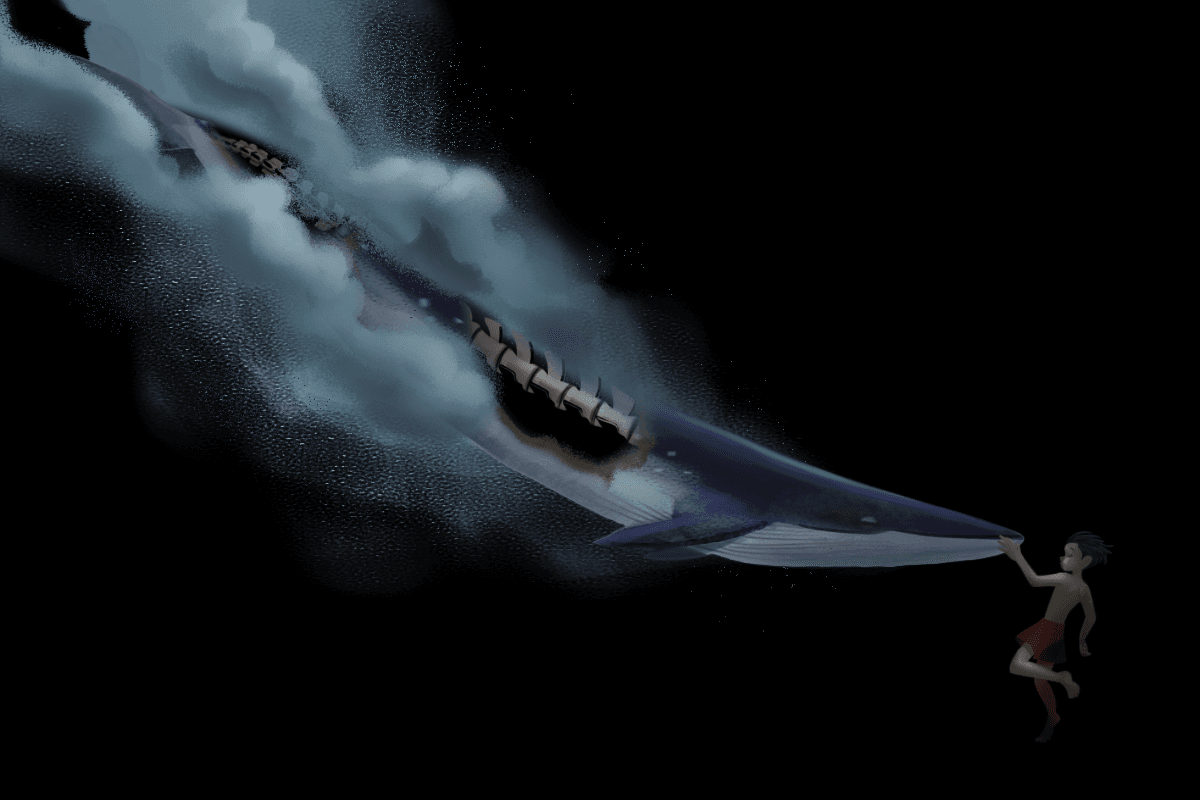
There are many stories about whales saving people in Vietnam. For example, a man named Mùi was saved by a whale when his boat capsized. He was very grateful and now takes care of a whale graveyard in Phước Hải Village. Mùi believes that whales are very kind and will help anyone in need, not just Vietnamese people. He has heard stories about whales saving people from other countries, like America and Russia. Mùi thinks that whales are very special and deserve our respect.
A painting in Vũng Tàu's whale temple shows the importance of whales in Vietnamese culture.
I first learned about Vietnam's whale worship tradition from a photo caption. I was curious to learn more, so I traveled to the coast to talk to people who practice this tradition. Some of my friends from Saigon had heard of it, but they didn't know much about it. I wanted to learn more, so I went to the sea to find out.
I visited a small town near Vũng Tàu and saw a whale graveyard. The graveyard was in a remote area, and I had to walk through a construction site to get there. When I arrived, I saw many mounds with tombstones, each one marking the grave of a whale that had washed up on the shore.
A woman was arranging offerings at the whale graveyard in Phước Hải Village.
A woman at the graveyard told me that she comes from a family of fishermen. She leaves offerings at the graves and prays to Cá Ông to ensure a good catch and a safe journey. The fishermen often work far out at sea, so they need all the help they can get. The woman believes that the whales will help them if they show respect and gratitude.
Mùi, the caretaker of the whale graveyard, told me that whales don't just save people from drowning. They also help fishermen who are in trouble. For example, some fishermen were caught by the authorities in Indonesian waters, but they prayed to Cá Ông and were able to escape. Mùi believes that whales have special powers and can help people in many ways. He also thinks that praying to Cá Ông can bring good health and luck in finding a husband or wife.
A scholar named Sandra Lantz studied whale worship in central Vietnam. She found many stories about whales saving people, just like the ones Mùi told me. For example, a man named Ly was fishing when a big storm hit his boat. He prayed to Cá Ông and was saved. Lantz's research shows that whale worship is an important part of Vietnamese culture.
Lantz also found that people believe Cá Ông helps the souls of fishermen who die at sea. If the souls can't get to land, they will wander the ocean forever. But if Cá Ông brings them ashore, they can rest in peace.
Scientists have a different explanation for the stories about whales saving people. They think that whales might be using boats as a way to steady themselves in rough seas. Sometimes, whales get exhausted and die, and their bodies wash up on the shore. This might be what people interpret as a whale sacrificing itself to save a human.
The Phước Hải graveyard has many mounds, each one containing the body of a whale that washed up on the shore. Some years, up to 20 whales end up on the beach. The villagers don't really distinguish between whales and other sea creatures, like dolphins and porpoises. Many of the animals they find are small, so they might not be whales at all.
A large burial mound in Phước Hải Village whale graveyard is a notable landmark.
One grave in Phước Hải stands out because it's very big. A huge whale washed up on the shore in 2017, and it took a crane to move it to the graveyard. Mùi said it was over 10 meters long, but the woman who was leaving offerings thought it was more like 7 or 8 meters. Either way, it was a very big whale.
Mùi told me that the big whale had saved many ships during its lifetime. It had even saved ships in other countries, like Thailand and Russia. But when it failed to save a ship in a big storm, it killed itself out of shame or grief. This is what the villagers believe, anyway.
An altar dedicated to Cá Ông at the Phước Hải Village whale graveyard is a place of worship.
When a whale washes up on the shore, the villagers give it a big funeral. They play drums and offer food, drink, and other gifts. The whale is put in a bamboo coffin lined with red paper, and then it's buried in the graveyard. Sometimes, whales are too big to move, so the villagers will watch over them until they can be buried.
The first person to find a whale is said to be very lucky. But only older people should bury the whale, because the soul of the whale might still be present and could inhabit a younger person's body. Each grave has a tombstone with the date of burial and the name of the person who found the whale.
A Cá Ông altar in Phước Hải is a place of worship and offerings.
The villagers take care of the whale graves for three years. They leave offerings and say prayers, and they even have special ceremonies to mark the anniversary of the whale's burial. After three years, the bones are dug up and taken to a special temple, where they are kept as a reminder of the whale's importance.
An altar base filled with cetacean bones is a symbol of the villagers' respect for whales.
I visited the Lăng Ông temple in Phước Hải, which is dedicated to Cá Ông. The temple has a big room with an altar and many whale bones, including a big skeleton. The temple is also a community center, where people can come to pray and socialize.
The entrance to the Vũng Tàu temple dedicated to Cá Ông is a notable landmark.
The temple in Vũng Tàu is similar to the one in Phước Hải. It has a big room with an altar and many whale bones, including a big skeleton. The temple was built a long time ago, and it's still an important place of worship today.
Thứ Hải, a monk at the Vũng Tàu whale temple, is a knowledgeable guide.
Thứ Hải told me that everyone in the area knows about the power of Cá Ông. They come to the temple to pray and ask for prosperity. The temple has many old photographs on the wall, showing whale funerals and other ceremonies.
The villagers have a big festival every year to honor Cá Ông. They leave offerings, say prayers, and have boat races and other activities. The festival is a time for people to come together and show their respect for the whales.
The villagers have many superstitions about whales. For example, they think that eating certain foods, like swordfish or dog meat, can bring bad luck. They also think that wearing certain jewelry, like claws or teeth, can scare away the whales.
Mùi and his friend Ngọc are two of the people who take care of the whale graveyard in Phước Hải.
Mùi told me that the dietary restrictions are similar to those in Buddhism. Some people choose to follow them, while others don't. He also said that people are careful not to offer chickens to Cá Ông, because it might be bad luck.
The origin of whale worship in Vietnam is not clear. Some scholars think it might have come from the Chăm people, who were seafarers and had a strong connection to the ocean. Others think it might have come from Hindu animist beliefs.
Buddhism also has a story about the origin of whale worship. According to legend, a bodhisattva named Avalokitesvara created whales to help fishermen in distress. The whales were given the task of rescuing people and bringing them to safety.
The future of whale worship is uncertain. As younger people move to the cities and leave their traditional way of life, they might forget about the importance of Cá Ông. The development of the coast and the impact of climate change might also threaten the tradition.
Whale spinal bones at Phước Hải Lăng Ông are a reminder of the importance of whales.
Mùi doesn't think that the tradition of whale worship will disappear. He believes that people will continue to respect and honor Cá Ông, even if they're not fishermen anymore. The monk in Vũng Tàu also thinks that the tradition will continue, and that people will always come to the temple to pray and show their respect.
The government has recognized the importance of whale worship and has taken steps to protect it. For example, the Ministry of Culture has recognized the whale festival as an important part of Vietnam's cultural heritage. The government has also invested in restoring old temples and building new ones.
A whale skeleton is displayed in Vũng Tàu as a symbol of the importance of whales.
It's easy to romanticize old traditions and think that they're connected to modern values. But the reality is that whale worship is not really about protecting the environment or conserving whale populations. It's more about the cultural and spiritual significance of whales in Vietnamese society.
The reality is that whales are often hurt or killed by human activities, like fishing and pollution. Many whales that wash up on the shore have died from getting tangled in nets or eating plastic. It's a tragic reminder of the impact that humans have on the ocean and its inhabitants.
As I sat with Mùi, I felt conflicted about whale worship. On the one hand, I admire the respect and gratitude that people have for whales. On the other hand, I wonder if the tradition is really helping to protect whales or if it's just a way to justify human activities that harm the ocean.
In the end, it's not my place to judge. I visited the altar and prayed for the survival of the whales, and for the prosperity of the village. I hope that the tradition of whale worship will continue, but I also hope that people will become more aware of the impact that humans have on the ocean and its inhabitants.
This article was originally published in 2018.