

The Surprisingly Global History of Monobloc, the Chair Vietnam Loves and the West Despises
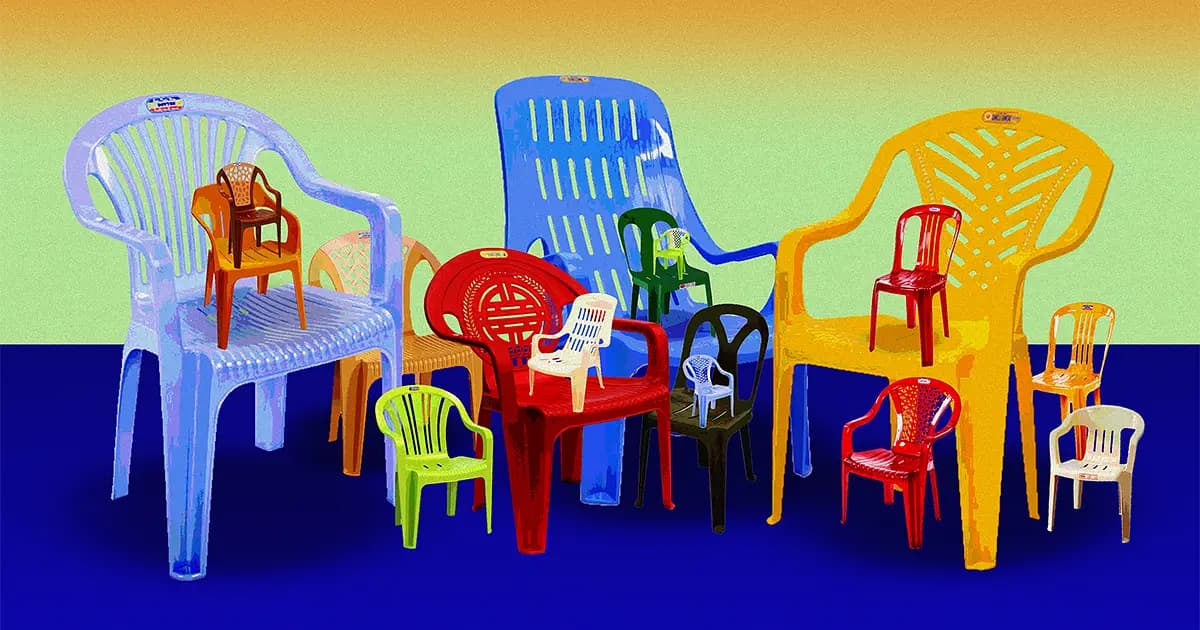
Vietnamese news sources were quick to jump on the story. The chair's role in fostering Vietnam’s culinary and social gatherings was noted. It is present at beer stalls, in family courtyards, and various scenes throughout the country.
The Monobloc was the only entry without a credited creator.
There were conflicting interpretations regarding the chair's inclusion. The Monobloc was chosen for its absolute, relentless ubiquity. Millions, perhaps billions, of them have been produced and scattered across the world.
Global sentiment toward the Monobloc is split into two opposing camps. In many countries, people despise it openly, describing it as an eyesore that clutters the landscape and an environmental blight. Yet elsewhere, particularly in Vietnam, the chair is spoken of with a certain fondness.
The local press quickly capitalized on the Monobloc making the list.
How can something so simple be both cherished and disdained? What exactly about it is so appealing to some and so offensive to others? Is it genuinely useful, or merely plastic waste masquerading as furniture?
To find an answer, we have to trace the chair back to its inception.
The Monobloc is cast from a single mass of plastic. It is typically made of polypropylene, a thermoplastic that yields to shape under high heat.
The chair first emerged in the aftermath of the World Wars, as nations lunged toward industrialization. At the time, plastic was hailed as the substance of the future because it was light, durable, and did not rely on traditional resources like wood or metal.
Designers began experimenting with plastic as a new frontier for mass-market furniture. The hope was to create products that were flexible, inexpensive, and more accessible to the general public.
Many would-be precursors to the modern Monobloc were developed during this era.
The Panton Chair, Bofinger Chair, Universale Chair, and Fauteuil 300 were some of the notable designs.
The Fauteuil 300 possessed the silhouette we recognize today: slim, equipped with armrests, and very stackable.
The real turning point was in 1983, when the French Grosfillex Group launched its Resin Garden Chair. This was designed for the mass market with exceptionally low production costs.
The Monobloc is the result of meticulous calculation. The backrest is perforated to drain rainwater for outdoor use.
Inside a chair factory, the production process takes less than two minutes.
The greatest expense in this production line is the mold itself. A single set can churn out millions of perfect copies, distinguished only by color.
A beach in Naples, Italy, is one of the many places where the Monobloc can be found.
The Monobloc possessed everything needed to take over the world. From France, it quickly swept through Europe and crossed the Atlantic to North America.
Critics accused the Monobloc of being in the worst possible taste and cheap, ugly, and everywhere.
In cities like Zurich and Barcelona, local governments have gone so far as to banish the Monobloc from public spaces.
Two chairs at the Dead Sea are a testament to the chair's global presence.
The journey of the Monobloc in the so-called developing world offers a starkly different perspective.
The documentary Monobloc by Hauke Wendler reveals a different reality.
The film captures the complaints of Germans before moving to other countries to see how the chair is actually used.
In India, the Monobloc changed the fact that many poor households did not even own a proper chair.
From top to bottom, left to right: Monobloc chairs in Germany, Brazil, India, and Uganda.
In Brazil, residents in impoverished neighborhoods rely heavily on waste picking for a living. At local recycling workshops, broken plastic chairs are collected, shredded, and melted down to be cast into entirely new objects.
The story takes an even more resourceful turn in Uganda. The Monobloc serves as the primary frame for low-cost wheelchairs distributed by the organization Free Wheelchair Mission.
A Monobloc on a Vietnamese train car is a common sight.
A Monobloc wheelchair in Đà Nẵng is a testament to the chair's versatility.
People's relationship with the Monobloc mirrors the condition of their environment.
In less privileged regions, the Monobloc is seen as a precious commodity and a practical solution to their community's lack of resources.
In more affluent societies, familiarity breeds contempt. The Monobloc is often dismissed as a mere byproduct of mass production.
This article is by no means an indictment of the western framework, nor is it an absolute verdict on which perspective holds more weight.
Encountering the Monobloc through these global accounts, I find myself returning to the same question posed at the beginning: what, exactly, is this chair at its core?
The only answer I can offer is a personal one.
As a Vietnamese, I find my idea of the chair at odds with many of the aforementioned notions.
I’m immensely grateful for the livelihood it has given me and my fellow countrymen, in many ways.
In the big way, I’m grateful that it has provided stable seating for beer-bellied uncles catching the evening breeze by the canal.
Photo via Flickr.
I’m inclined to be biased, of course, as some of the best meals and best times I've had happened on various incarnations of the Monobloc.