

Understanding 'Making a Whore': A Novel of Colonial Vietnam
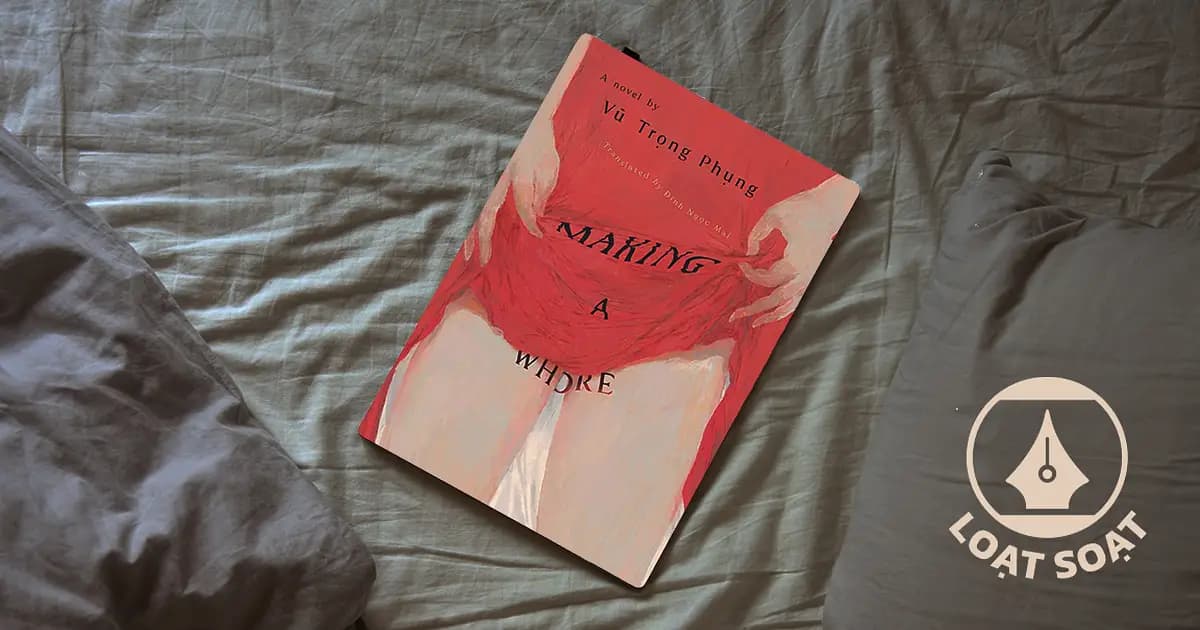
Vũ Trọng Phụng was a prolific writer known for his satirical novel 'Số đỏ' or 'Dumb Luck'. He criticized westernization and the rise of the bourgeoisie in colonial Vietnam. Many Vietnamese know 'Dumb Luck' from school, and Phụng is considered one of the greatest writers of 20th-century Vietnam.
When 'Making a Whore' was first published, it was controversial. Critics debated whether it was pornography or a contribution to sex education. Today, the debate seems silly because the novel is not explicit or informative about sex. However, it offers insights into gender and sexuality in late colonial Vietnam.
Image via Facebook page Mộng Tình Lâu.
Phụng wrote that his novel aims to urge parents to care for their children's happiness and pay attention to sexuality. The new translation is a major step forward in expanding English-language readership and scholarship on Phụng and his views on sex, gender, and colonial modernity.
The novel starts with two friends visiting a licensed brothel. They are surprised to see Huyền, a girl from their high school, working as a prostitute. The friends abandon their original purpose and ask Huyền about her life.
Huyền's story is told in a novel within a novel, structured into four chapters. As her life progresses, her 'sexual crisis' spirals out of control. The novel is accessible and relatively short, with a straightforward tone and style.
The question is, who or what is to blame for Huyền's corruption? For Phụng, the answer is the lack of proper sex education and the influence of westernization.
Huyền reflects on her life and says that her flawed education system and unsavory company led her to prostitution. Phụng argues that Huyền's sexual 'perversions' are a result of her repression and improper sex education.
As a child, Huyền was curious about her mother's pregnancy, but her father disapproved of her question. Without proper sex education, Huyền explored her sexuality through other means, such as masturbation and reading about sex.
Phụng also blames westernization and materialism for Huyền's corruption. Huyền says that her 'corruption' began with a pair of white trousers, which symbolized a 'modern' woman's look.
The meeting of East and West in Vietnam influenced people's material lives. Phụng argues that accepting western lifestyle without recognizing the need for sex education is absurd.
The title 'Making a Whore' is significant because it reflects Phụng's attitude towards sexual corruption. For Phụng, a 'whore' is not something someone chooses to be, but rather is 'made' by larger factors.
While 'Making a Whore' contains elements ahead of its time, it also has analytical flaws. One flaw is the concept of 'corruption', which is not clearly defined.
The Vietnamese-language cover of a previous edition of 'Làm đĩ'.
The concept of 'corruption' is difficult to determine because Phụng draws from various influences, including Freud and traditional Sino-Vietnamese discourses.
For example, the 'educational book' that Phụng reads relies on the theory of yin and yang to denounce masturbation. However, the concept of 'corruption' resists a coherent framework.
The amorphous quality of 'corruption' may be the point. 'Corruption' can be understood as an expression of Phụng's ideals for Vietnamese society, rather than an objective category.
If prostitution is 'wrong', it is not because it is sexually 'corrupt', but because of its exploitative conditions under gendered capitalism.
The novel is also analytically confused in its treatment of materialism. Phụng fails to differentiate between materialism and capitalism, which leads to a flawed analysis of Huyền's 'corruption'.
What ultimately pushes Huyền into prostitution is not corruption via materialism, but rather economic necessity and the structure of patriarchy that curtailed women's socioeconomic freedoms.
Making a Whore is analytically messy and full of tensions and contradictions. However, these flaws make the book an engaging and fascinating read, revealing much about its time and the debates on gender, modernity, and capitalism.