

A 1967 French Film About the Vietnam War
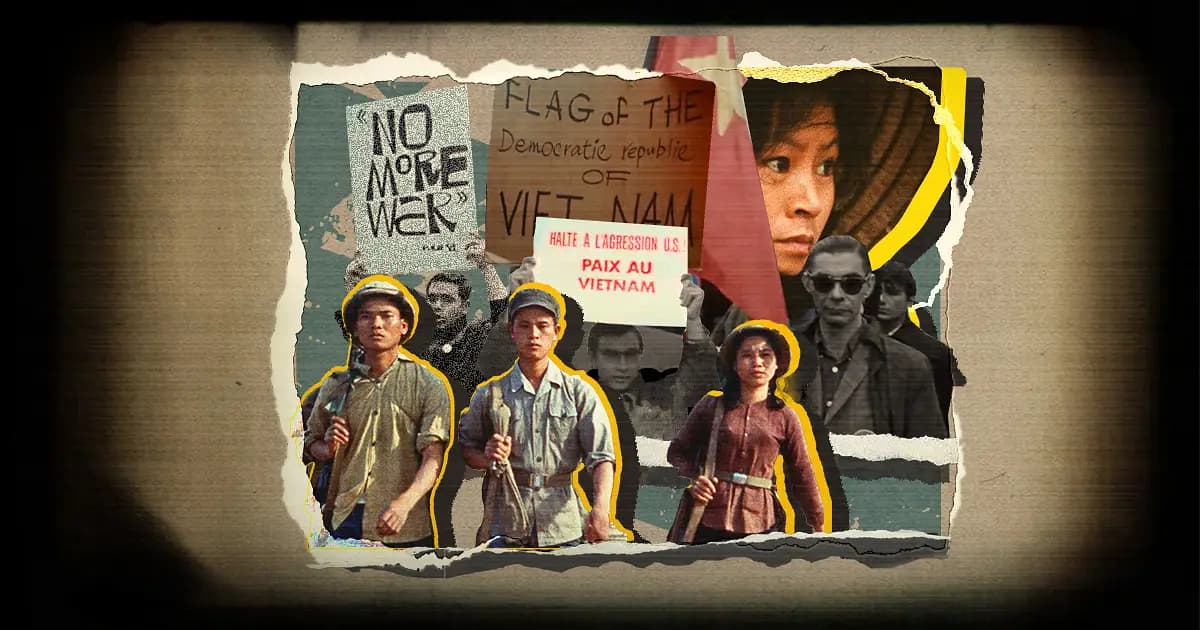
Most people in France did not like the war in Vietnam either. They thought it was unfair to the Vietnamese people. After 1965, many people in France were against the war. So, when some artists sent medicine to Vietnam, it was surprising that many filmmakers did not do anything.
One filmmaker, Chris Marker, decided to make a movie about Vietnam. Marker was different from other filmmakers because his movies were like essays. He wanted to explore how art and politics could work together. His movie, Loin du Vietnam, was a result of this.
The film poster for Loin du Vietnam is simple.
Loin du Vietnam is a hard movie to describe. Many filmmakers, including Joris Ivens and Jean-Luc Godard, worked on the movie together. They made a movie with 11 parts that came out in 1967. The movie is not just about the war in Vietnam, but also about how people think about the war.
The movie starts with a voice-over that sets the tone for the rest of the film.
There is a scene in the movie that shows Vietnamese soldiers.
The movie shows how different the war was for the US and Vietnam. The US had a lot of power and technology, while the Vietnamese people had to hide in the fields. The movie says that the war is unfair and that the US is fighting against the Vietnamese people's right to be free.
One part of the movie, made by Joris Ivens, shows how people in Hanoi built shelters to protect themselves from bombs. Ivens filmed the shelters and the people who built them. He also showed how calm the people were, even though they were in danger.
There is a picture of boys playing near bomb shelters in Hanoi.
The movie shows how strong the Vietnamese people are, even though they are fighting against a powerful enemy. The movie also says that the US does not understand the power of the poor and the oppressed.
The movie has footage from outside Vietnam, which shows how people around the world were affected by the war. One filmmaker, William Klein, filmed a demonstration in New York City.
William Klein was a US citizen who filmed the demonstration.
Klein's footage shows how people in the US felt about the war. He filmed a parade in New York City where people were protesting the war. The parade was a mix of people from different backgrounds, all united against the war.
The movie also shows a famous parade led by Martin Luther King Jr. The parade was one of the biggest demonstrations against the war, with over half a million people attending.
There is a picture from the movie that shows a protest in New York City.
The movie talks about the history of the war and how it is connected to other conflicts. One part of the movie, made by Alain Resnais, shows how the war is part of a bigger struggle against imperialism.
The Situationist International, a group of artists and activists, influenced the movie's style and message.
The movie is not just about the war in Vietnam, but also about the role of intellectuals and artists in society. The filmmakers were aware of their own biases and limitations, and they tried to be honest about them.
In the 1940s, many French people did not know about the war in Indochina. But by the 1960s, many more people were aware of the war and were against it.
One part of the movie, made by Alain Resnais, shows a fictional character who is struggling with his own feelings about the war. The character is a French intellectual who wants to support the Vietnamese people, but is not sure how.
There is a picture from the movie that shows the fictional character.
The character's story is complex and nuanced, and it raises questions about the role of outsiders in a war. The filmmakers were aware of their own limitations and biases, and they tried to be honest about them.
The movie is not just about the war in Vietnam, but also about the role of art and intellectuals in society. One filmmaker, Jean-Luc Godard, talks about why he wanted to make a movie about the war.
Jean-Luc Godard is a famous filmmaker who contributed to the movie.
Godard talks about how he wanted to film the war, but was not able to go to Vietnam. He says that he would have liked to show the effects of the war on the Vietnamese people, but he was not able to do so.
Godard's part of the movie is a reflection on the role of the filmmaker and the importance of being honest about one's own limitations. He says that he wants to 'let Vietnam invade us', meaning that he wants to learn from the Vietnamese people and their struggle.
The movie uses footage from a Fidel Castro interview to make a point about resistance and struggle.
The movie is a complex and nuanced exploration of the war in Vietnam and its impact on the world. It is not just a documentary, but a work of art that raises questions about the role of intellectuals and artists in society.
The movie was not widely seen when it first came out, but it has been restored and is now available to watch.
Loin du Vietnam is a powerful and thought-provoking movie that is still relevant today.