

Vietnam’s Modernist Architecture Resurges: How Nostalgia, Documentation, and Commerce Converge
A 2024 Ministry of Construction study found that structures erected before 1975 now constitute merely 15 % of Vietnam’s built environment, underscoring how much of the post‑independence modernist fabric has already vanished.
Founded in 2015 by Mel Schenck, Tom Hricko, Tim Doling, and Hoanh Tran—with Saigoneer as an early sponsor—the group spent a decade as a quiet archive for disappearing mid‑century houses, but it now teeters on the brink of mass admiration, its comment threads overflowing with exclamations of “Đẹp quá!” and nostalgic reverie.
The engine of this revival is unmistakably urban nostalgia: in a country where skylines are constantly being rewritten, the plain grey shophouses and modest modernist villas have become mnemonic anchors, prompting citizens to treat photographs of them as visual madeleines that summon collective memories of a vanished Vietnam.
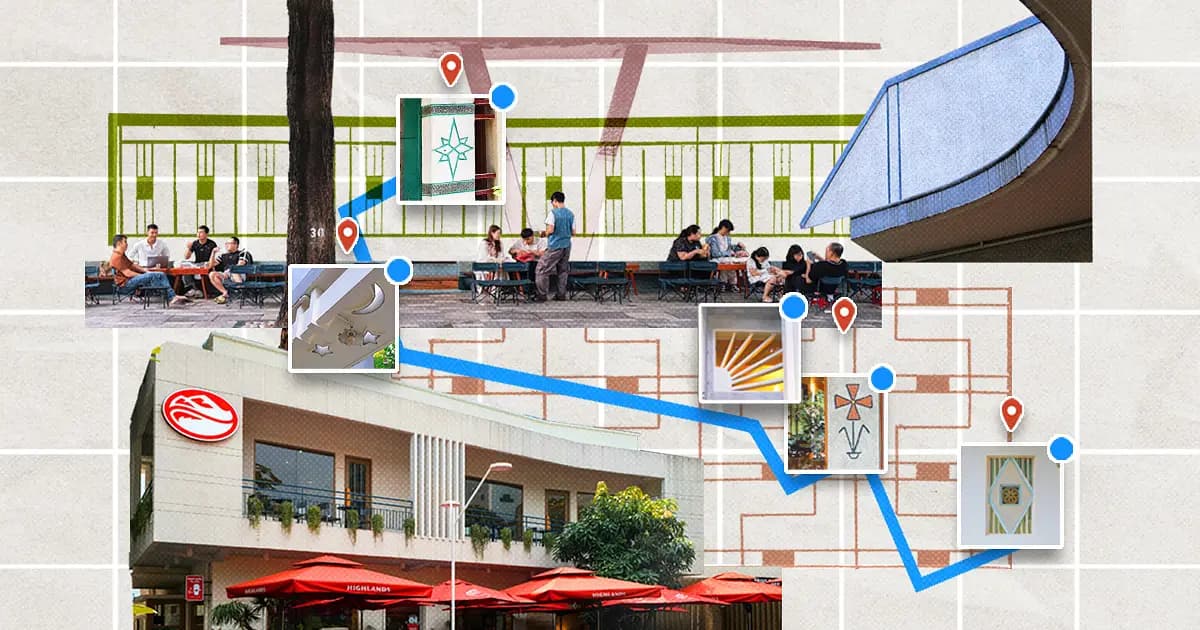
Commercial actors have seized the moment. In 2024 Cà Phê Linh opened a café in Xuân Hòa that was not a restoration but a ground‑up construction adhering rigorously to mid‑century modernist codes—stone‑washed façades, star‑and‑moon pergolas, and diamond‑patterned tiles—and, buoyed by its popularity, launched a second outlet in Saigon in late 2025. Meanwhile, Highlands Coffee repurposed a modernist villa on Hoàng Văn Thụ into its first drive‑thru, a move that ignited a TikTok campaign whose most viral clips surpassed one million views.
The catalyst may have been the May 19 announcement that the historic modernist leprosy village Quy Hòa would be displaced to make way for a 40,000‑resident tourist mega‑resort; the news arrived precisely as activity on the Facebook group surged, turning a preservation alarm into a rallying cry.
Taken together, the resurgence rests on three interlocking strata: scholarly documentation that validates the style’s cultural worth, a sociological wave of nostalgia that transforms ordinary concrete blocks into cherished symbols, and a commercial layer that translates sentiment into marketable experiences—each reinforcing the other in a self‑propelling feedback loop.