

What Does "Expat" Really Mean? A Simple Look at a Controversial Word
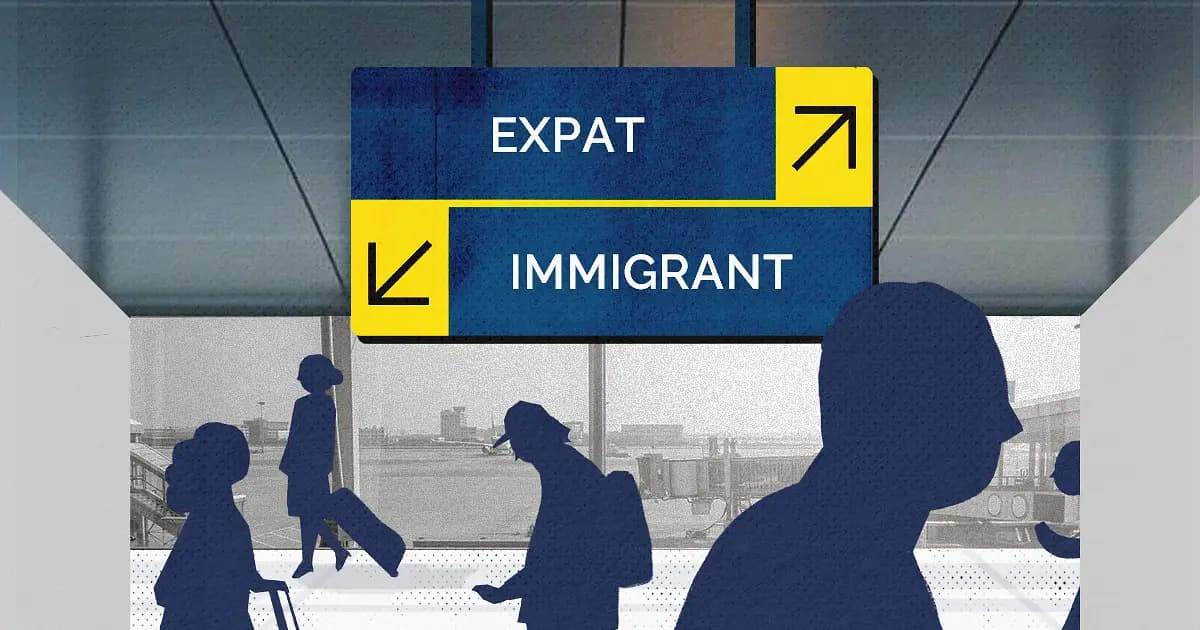
The claim says "expat" is mostly for white Europeans and people from the West. It gives them a sense of status that other groups do not get. A recent case involved a Dutch‑run running club in Bali. Some Instagram users said the club called locals "immigrants" but called white people "expats". Fred Wissenk wrote in Vietcetera that white people are automatically called expats. He suggested we should call all foreigners expats. The debate shows how the word can create division.
The Bali running club that was accused of treating locals unfairly. Photo credit: The Guardian.
Saying the word "expat" is always racist is too simple. Many non‑white people are also called expats. For example, South Asian workers lived in East Africa during British colonial rule. This shows that expats have always been diverse. We also need to ask if any word can be truly racist on its own. Words change meaning depending on where and how they are used. The term can be racist when used to separate a white expat from an Arab immigrant, but it is not automatically racist in every context.
The word "expat" is hard to define. Official definitions differ from how people use it daily. Some people call themselves expats, while others are labeled that way by outsiders. So, what does "expat" really mean in Vietnam? How is it different from "immigrant" or "migrant"? The Cambridge Dictionary gives a basic definition that we can start from.
First, an expatriate moves to another country, while a migrant may move within a country or cross borders. Academics often treat expats as a type of migrant. In practice, many writers separate the two. For instance, a Việt Nam News columnist first used "migrants" and then added "(sorry, expats, that means you)" to show the distinction.
Another key difference is how long someone plans to stay. Immigrants usually plan to live permanently. Expats often have an unclear or short‑term stay. In reality, people often use "expat" for wealthy, educated professionals, while calling others "immigrants." Sarah Kunz notes that expats can range from CEOs to teachers, volunteers, yoga instructors, and even unpaid interns. She observed in Nairobi that some expats live luxuriously, some struggle, and some rely on family support back home.
A foreign teacher in Hanoi. Photo credit: Tuổi Trẻ.
In many languages, there is no exact word for "expat." Vietnamese usually says "người nước ngoài" (foreigner) or "người tây" (westerner). Korean also uses "oekuk‑saram," meaning foreigner. French "expatrié" is similar to English, but Spanish "expatriado" often means exile, which was the original English sense before the 1900s.
Even English speakers use the word differently around the world. In the United States, people rarely say "expat" because the country sees itself as a land of immigrants and because staying long‑term is harder. In Gulf states, all foreign workers – from construction laborers to senior managers – are called expats. This helps keep non‑citizens feeling separate from the nation. In Vietnam, people rarely separate expats from immigrants, but the term still carries hidden meanings.
Workers in Dubai. Photo credit: The New York Times.
Because "expat" has many meanings, calling it simply racist is too narrow. A better view is that the term is often racialized. To explain, think of the word "human." Leonardo da Vinci’s Vitruvian Man shows a white male body as the ideal. That image helped link the idea of "human" with white, male standards, even though the concept itself is not inherently racist. Similarly, "expat" is not always racist, but it is often used in ways that favor white, wealthy people, and it also reflects class and gender biases.
The racialized view of expats comes from colonial and capitalist history. Historians see three stages. First, colonial expats like British officers in India, who were portrayed in novels as tired, alienated, and sometimes alcoholic.
Servants around a British general and his guests in Bangalore. Photo credit: The New Statesman.
After World War II, anti‑colonial movements changed the meaning of "expat." The United States became the new global power, and its multinational companies grew quickly. These companies needed a new kind of worker – employees sent abroad for short‑term projects, called corporate expatriates.
When the colonial model faded, the 1980s‑1990s brought neoliberalism – less government control, more global trade, and rising inequality. This shift created a new type of expat who worked for private firms under flexible, often precarious contracts.
In Vietnam, the economic reform called Đổi Mới opened the country to foreign firms. Shell, a big oil company, hired many expats in the 1990s. Kunz says these workers got more freedom but also faced more competition and pay gaps. Earlier, Shell staff felt like a "Shell family," but later they became independent global workers, reflecting neoliberal values.
Travel writer Mark Hudson and his friends at the Majestic Hotel in 1992. Photo credit: Saigoneer.
A newer type of expat is the self‑initiated expatriate (SIE). These are skilled people who move abroad on their own, such as digital nomads, English teachers, travel influencers, and freelancers. SIEs did not replace corporate expats, but they became the most visible model. They often appear as independent, border‑less professionals, yet their ability to travel still depends on passports, money, and immigration rules. Kunz writes that this self‑styled global person can seem heroic but may hide deeper structural privilege.
A view of Thảo Điền, a popular expat area in Saigon. Photo credit: Vinhomes.
Even though SIEs seem diverse, they are still often seen as white. Kunz argues that the flexible definition of "expat" hides its racial bias. The label suggests a borderless world, but in reality it reflects lingering colonial and neocolonial power structures. This is why many still criticize the term as favoring white people, even though non‑white expats exist.
The overall history shows that "expat" has been shaped by colonial, corporate, and neoliberal forces, making it a racialized label worldwide. In Vietnam, the picture is more mixed because many East Asian workers are also called expats. In 2025, most foreign employees in Vietnam came from China, South Korea, or Japan. A Vietcetera interview featured six expats, five of whom were not white, working as managers, yoga teachers, and ESL instructors.
The opening ceremony of a Coca‑Cola plant in Hà Tây Province (now Hanoi) in August 1995. Photo credit: Hoàng Đình Nam via Instagram @tonkin.jpg.
Even in Vietnam, the term is not completely free of race. Asian expats are often shown in articles about work, while Western expats appear in pieces about lifestyle. This shows that "business" expats (often Asian) and "lifestyle" expats (often Western) are treated differently, reflecting separate racial stereotypes.
A study of Korean expats in Saigon found they call their stay a "long‑term business trip," unlike many Western expats. This does not mean race is irrelevant, but that it works in a different way because many Asian companies invest heavily in Vietnam. The Korean community, for example, lives mainly in District 7 and keeps to itself, while other expats are spread across the city. Estimates say about 100,000 Koreans and 50,000 other foreigners live in Saigon, showing multiple expat groups rather than a single community.
View of Phú Mỹ Hưng, often called Saigon’s Korea town. Photo credit: VnExpress.
It may look like Vietnam treats all foreigners the same, but two examples prove otherwise. Both cases show that the word "expat" can hide class and race issues.
First, Vietnam has long imported labor from abroad, especially Chinese workers for construction projects. Anthropologist Nguyễn Văn Chính says about 33,000 Chinese contractors work in the north, many hiring fellow Chinese for easy communication. Most of these workers have short, often illegal contracts lasting three months to a year, though some stay up to ten years. Official definitions would call them immigrants, yet they are sometimes labeled "expats," highlighting how the term can be used to downplay their low‑status labor.
As much as 90% of Vietnam’s thermal power plants are built by Chinese contractors. Photo credit: UNDP.
The second case is the story of Kenneth Atkinson, a British businessman who became a Vietnamese citizen in 2025 after 30 years. Vietnamese media placed his story in the "Expat Life" section and used tags like "expat," never mentioning "immigrant" or "immigration." This shows how the label can be applied to very different people – a wealthy naturalized citizen and low‑paid Chinese laborers – without neutral meaning.
Naturalized citizen Kenneth Atkinson at his memoir launch in September 2025. Photo credit: VnExpress.
In the end, public talk about expats and racism is often too simple. A deeper look shows the term is tangled with empire, capitalism, and class. Some argue we should drop the word because it creates confusion. Others think it can stay if it marks privilege, but that may actually reinforce the very privilege it tries to identify. Because it is hard to measure who is privileged, keeping the term may keep the problem alive. For these reasons, many suggest we stop using "expat" altogether.