

The Webb Telescope Gets a Fix to Take Better Pictures of Bright Planets
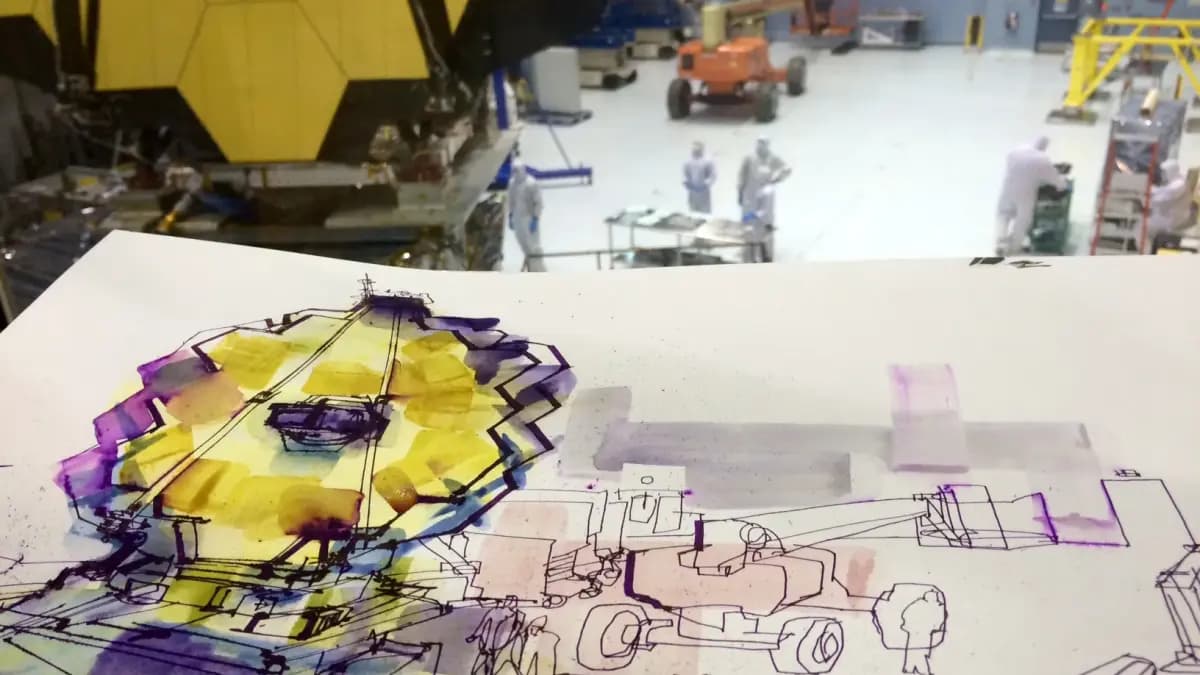
The Webb telescope was made to detect very faint light from galaxies and stars that formed after the Big Bang.
But the telescope has trouble taking pictures of bright objects like Mars and Saturn because they are too bright.
The planets are so bright that they flood the telescope's sensors with too much light. To fix this, astronomers use dark filters.
Now, there's a new solution that doesn't require astronauts to visit the telescope. Engineers are sending a software update to help the telescope take pictures of bright planets.
The new method, called 'superstripe,' will let the telescope safely take pictures of targets that are 100 times brighter than before.
Even the scientist who took Jupiter pictures with the Webb telescope in 2022 said the first images were blurry. The camera took several seconds to read the image while Jupiter's clouds moved.
The telescope later took better pictures of Jupiter by using shorter exposures and more selective settings.
The nicer Jupiter images were made possible by people who know how to process images. They were able to fix the blurry parts using the data.
But software can't fix light that was never recorded. Scientists tried to solve the problem by limiting the camera's view to a small box.
The new superstripe technique is an upgrade. Instead of taking one picture, the camera scans the planet in thin slices, taking many quick glances.
Because the camera captures each slice in a fraction of a second, it doesn't get dazzled by the glare. The software then puts the slices together into a single crisp picture.
Many astronomers want to use the Webb telescope to study nearby worlds. The telescope's location is its biggest advantage because it can look out into space without Earth's air getting in the way.
The Earth's atmosphere gets in the way of studying surfaces or atmospheres. That's why the Webb telescope is useful.
Even big telescopes on the ground have trouble seeing through the Earth's air because it absorbs certain types of light.
The new software could lead to new discoveries. It could catch rare moments when a planet or its moon blocks a background star.
It will also allow astronomers to observe exoplanets orbiting very bright stars outside our solar system.
The superstripe capability will be available next July. We can expect sharper views of our cosmic neighbors soon.
Topics NASA