

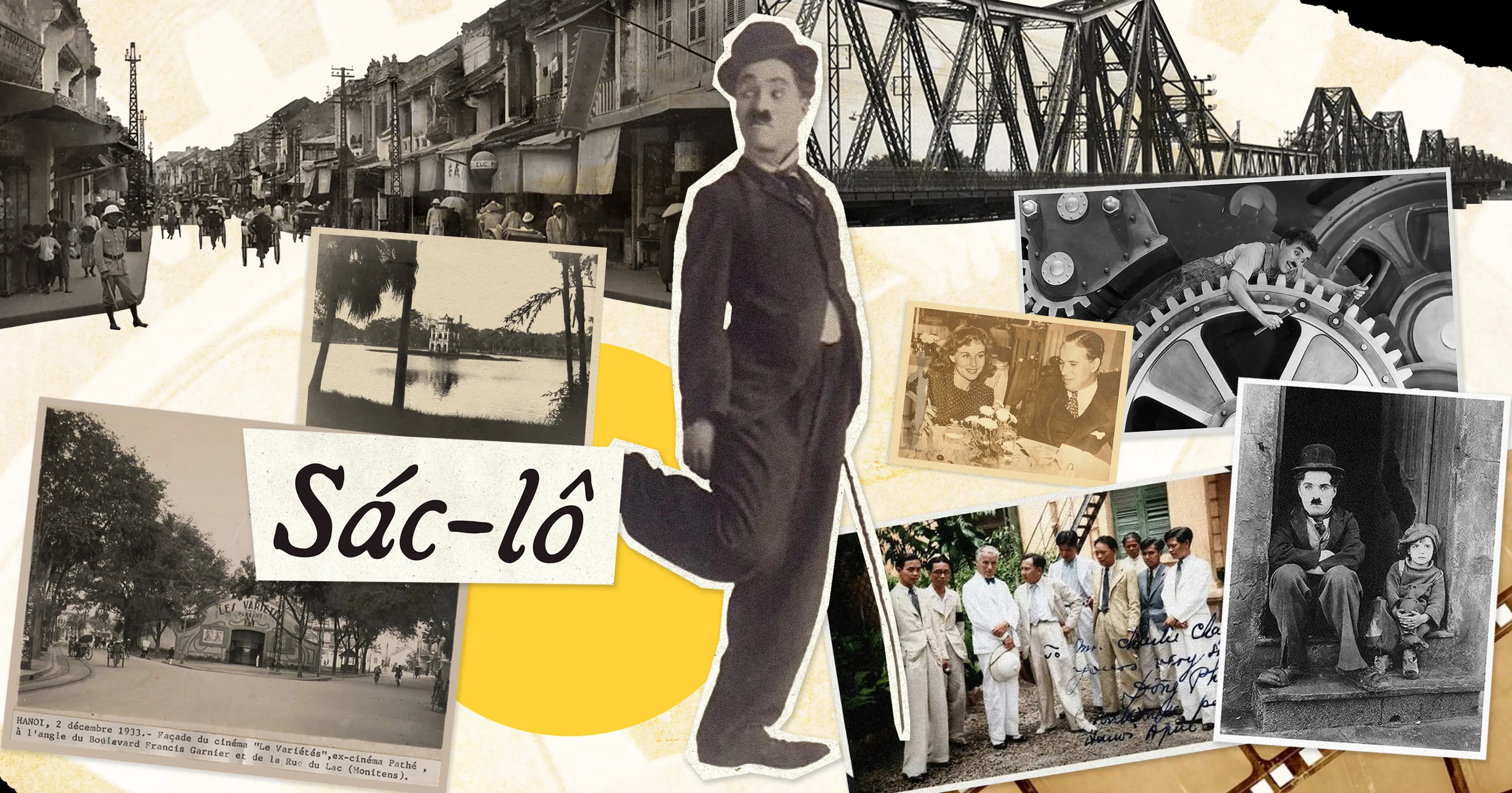
Charlie Chaplin’s 1936 Hanoi Sojourn: A Collision of Industrial Satire and Pre‑Industrial Colonial City
Chaplin và nghịch lý công nghiệp tại Hà Nội 1936
Source: Saigoneer
Modern Times, Chaplin’s 1936 masterpiece, deploys slapstick to indict the relentless march of industrialisation and the dehumanising logic of mass‑production. By foregrounding a hapless factory worker ensnared in conveyor belts, the film transforms comedy into a trenchant social critique.
Accompanied by his co‑star and future wife Paulette Goddard, Chaplin disembarked in Hanoi on the evening of 29 April 1936, taking up residence at the French‑quarter Metropole Hotel on Ngô Quyền Street. Their arrival was reported in contemporary press as a rare encounter between Hollywood royalty and the colonial capital.
Hanoi in 1936 was undeniably on a trajectory of modernisation—electric trams criss‑crossed the streets, new schools opened, and cinemas proliferated—yet, as writer Thạch Lam observed, the city possessed no factories or assembly‑line machinery. “In our land, there's no machinery, no factories at all,” he remarked, underscoring the stark dissonance between Chaplin’s cinematic tableau and the Vietnamese urban landscape.
Cinema first flickered in Hanoi in June 1916, when silent reels were projected in the Metropole’s ballroom; the city’s inaugural purpose‑built picture house, Pathé, opened in August 1920, while sound pictures only arrived in the mid‑1930s.
Locally, Chaplin was celebrated as Charlot—Sác‑lô in Vietnamese—a moniker derived from the French nickname for his Tramp persona. According to Hà Thành Ngọ Báo, he spent an afternoon at the Taverne Royale signing autographs for adoring fans, a vivid illustration of his celebrity status within the colonial milieu.
The juxtaposition of Chaplin’s anti‑industrial satire with a Hanoi that had yet to experience the factory floor he lampooned renders his visit a compelling study in cultural irony. It reveals how a Hollywood icon, whose wealth was generated by the very system he mocked, could find a fleeting sanctuary in a city whose modernization was still embryonic, thereby highlighting the uneven diffusion of industrial modernity across the colonial world.
You finished this article
Words from this article
12 recommended words · 0 looked up
Recommended
You looked up
You haven't looked up any word in this article yet.
Practice this article
PracticeRead next
 Latest NewsSociety · A2 · 1 min read
Why Thuan An Ward Stops New Tombs
Vì sao phường Thuận An cấm xây mộ mới
 Latest NewsEducation · B1 · 2 min read
Standardized Exams for Grades 5, 9 and 12: What It Means for Students, Teachers and Schools
Kỳ thi cuối kỳ thống nhất cho lớp 5, 9 và 12: Tác động đến học sinh, giáo viên và nhà trường
 Latest NewsSociety · B1 · 1 min read
Ho Chi Minh City Uses Fireworks and 3D Mapping to Celebrate Vietnam Culture Day
TP.HCM bắn pháo hoa, trình chiếu 3D mừng Ngày Văn hóa Việt Nam